By David Guenni
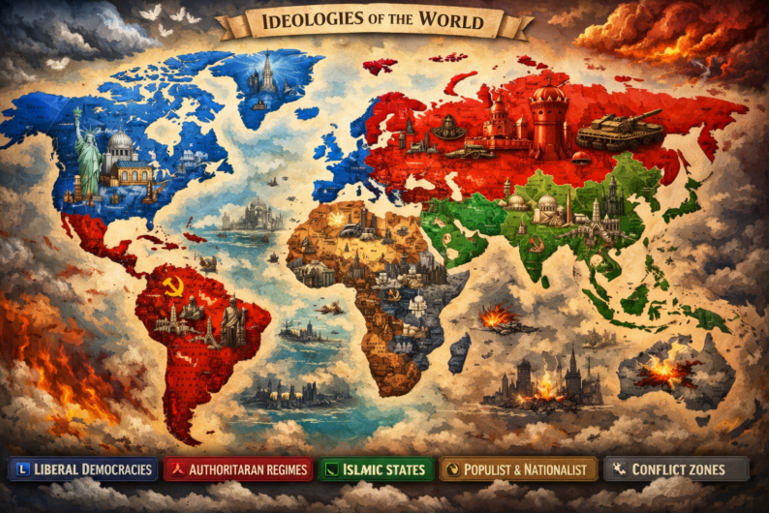
Ideology matters, as I learned from surviving 18 years under the Chavista regime in Venezuela. The United States pretended otherwise for three decades, clinging to the “end of history” and similar dreams. Today, with ideologically driven conflicts simmering around the world, it is time for America to integrate deterrence, defense, and a theory of victory across the so-called gray zone of geopolitics. Doing so will require policymakers to start listening to what America’s enemies have been saying for years about their ideological designs.
In 2004, when questioned about whether a Venezuela-Cuba alliance was exporting communist revolution throughout the Western Hemisphere, the Venezuelan ambassador to the United States averred: “It is a thing outdated in time and it is not understanding the relationships that exist between the countries.” That was a backhanded ‘yes,’ if there ever was one. The message was meant to assuage the busy, post-9/11 national security community, diverting attention away from the problems brewing south of the U.S. border. More than two decades later, the annual warnings of USSOUTHCOM Combatant Commanders before Congress have finally been heeded by the White House.
Ideology has been slapping America in the face since the late 1990s. For this era of refocusing on state-based threats, it comes in these forms and many others: Beijing’s obsession with employing “united front” organizations to silence dissidents overseas; Moscow’s obsession with Ukraine, kicking off a murky war in 2014 that is now sustained conventionally; Tehran’s obsession with aiding and abetting proxy martyrs of the Islamic Revolution; Havana’s and Caracas’ shared obsession with waging “asymmetric war” on Western powers (which included flooding the American homeland with illicit narcotics); and Pyongyang’s obsession with subverting Seoul’s political processes and civic life. All these gray-zone efforts have an ideology at the heart. Their ideologies, variously rooted in Marxism, religion, and revanchism, drive the leaders of these states to employ irregular warfare tactics without any remorse and at any cost to civilians in the West or anywhere else. You will not find high degrees of intellectual coherence between these constructs; shared hatreds and collectivist doctrines and dogmas are cohesive enough for what now amounts to an anti-Western coalition.
Anti-Western adversaries became sneakier when strategizing and aligning with those espousing similar worldviews. They also became more convinced of their moral superiority. The U.S. national security community makes arbitrary distinctions between geopolitics and ideology. These distinctions obfuscate reality, which is already tough to comprehend, and lead to poor policymaking. Nowhere is this weakness more prominent than in the domain of irregular warfare. How did ISIS carve out its domain between Iraq and Syria, for instance, if not through the aid of its ideology?
Discussing rival-state ideology in the Departments of State, Defense, and Homeland Security seems to generate discomfort despite some strides to understand strategic cultures. It started with the spectacular triumphs of 1991. After Saddam Hussein’s defeat in the First Gulf War and the dissolution of the Soviet Union, international relations’ ideological variables have been marginalized in the Federal Government. The American bureaucrat could finally put ‘Sovietology’ to rest, and, with it, anything to do with alternatives to liberal internationalism. The term ‘Great-Power Competition’ continues the delusion; ‘strategic-ideological struggle’ captures reality much better.
Disclaimer: Ideologies are messy. Their study requires incredible levels of nuance, subtlety, cultural awareness, philosophical skill, and extensive interpretive room. It is not a field of expertise attuned nor prone to engineering solutions or linear responses, making it politically dangerous to confront ideological challengers. Bringing up ideology always risks alienating a group and hurting its feelings. Hence, American political leaders and senior officials have scarcely breathed a word about state-centric ideological conflict since the demise of the USSR.
This problematic approach is a vestige of America’s long-gone “unipolar moment.” Through mirror imaging, it takes our attention away from elements that the Western world’s rivals thrive on. Several foes of the West have developed highly complex irregular warfare doctrines, intelligently focusing on the types of operations that some of these actors can excel in, and backing off from the type of war that they know they cannot win. Because illegality is the common denominator to all irregular warfare activities coming from any type of challenger, ideological zeal and fervor are absolute strategic imperatives to the leaders of these revanchist entities. Indeed, during the Global War on Terror, we recognized it as an essential enemy warfighting capability. Ideology is the glue that authoritarians, totalitarians, and other extremists apply to bind together the domestic constituencies that they rely on for control and aggression. In ideology, those leaders find the corpus of thought and the narratives required to morally justify atrocities committed in pursuit of greed, territorial expansion, or a simple clinging to power.
Acknowledgement is growing that defeating mere symptoms of its rivals’ irregular warfare campaigns cannot bring American strategic victory or even achieve deterrence in the “gray zone.” Looking back at the U.S.-led quagmires of Afghanistan and Iraq, more observers have called for defeating root ideologies, rather than just crushing the fighters who currently espouse a certain ideology’s flavor-of-the-moment (e.g., Taliban, al-Qaeda, ISIS, Hezbollah, Boko Haram, al-Shabaab, FARC, ELN, etc.).
Defeating our enemies must include defeating their ideologies. This no longer demands global wars in the traditional (conventional) military sense. To defeat regime ideologies, whole-of-government efforts require dusting off forgotten or atrophied competencies that America used to cultivate, including the ‘dark arts’ of U.S. foreign policy. Washington needs to articulate once again what it believes in, beyond vague notions of stability, and bring like-minded allies to our side.
David Guenni is completing his doctorate with Missouri State University’s Graduate School of Defense & Strategic Studies. His research focuses on nation-states’ employment of narcotrafficking as an irregular warfare modality. He is a Venezuelan political asylum seeker in the United States, having spent many years in the struggle against the Chavista regime in Caracas. His opinions are his own and no one else’s.