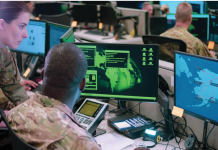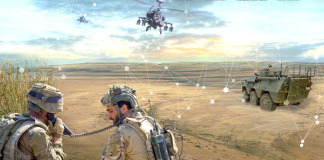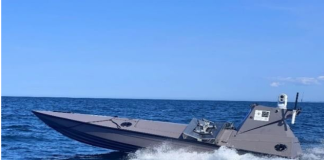
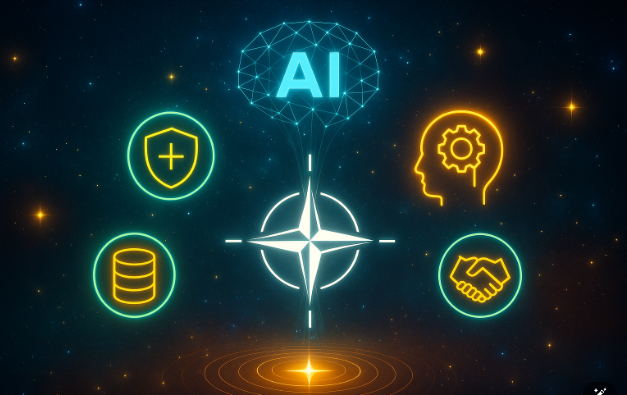
Imagine a future where artificial intelligence (AI) empowers NATO forces with unprecedented speed, precision, and insight. At the heart of this revolution lies Allied Command Transformation, the driving force behind NATO’s journey to harness the transformative power of AI for collective security. The Command is driving forward a wide range of initiatives that integrate AI across military operations, innovation, education, and capability development. These efforts reflect NATO’s broader goal of becoming a digitally transformed, data-driven, Multi-Domain Operations-enabled Alliance by 2030.
Laying the Foundation: Data as a Strategic Asset
Central to Allied Command Transformation’s AI work is a simple but powerful idea: data is a strategic resource. Just as healthier ingredients lead to better meals, high-quality and well-organized data is essential for AI to perform effectively, reliably, and responsibly. Without data that is accessible, shareable, and easy to understand, AI tools cannot live up to their full potential.
To make this vision a reality, Allied Command Transformation is leading efforts to improve how data is managed and used across NATO. This includes the implementation of Data Exploitation, which helps the Alliance build the right structures, rules, and practices for using data more effectively. One such effort, the Data Exploitation Programme, brings together NATO’s operational and transformational leaders, and focuses on turning real-world needs into practical use cases, encouraging responsible data sharing, and making sure NATO’s tools and systems speak the same digital language.
Through this lens, Allied Command Transformation champions a workforce skilled in data and AI and supports standardization efforts to ensure that data is trustworthy and usable across NATO systems. This data-first approach is paramount for the effective and responsible integration of AI into NATO’s capabilities. And with that groundwork in place, the Command is translating promising concepts into practical tools that support operations and decision-making across the Alliance.
From Concept to Capability: Advancing Practical AI Solutions
One of Allied Command Transformation’s most impactful contributions to NATO’s digital transformation is the advancement of operationally-relevant, practical AI solutions and prototypes. These initiatives serve as proof-of-concepts showcasing how AI can accelerate decision-making, unlock operational efficiencies, and strengthen situational awareness.
A prime example is AI FELIX (Artificial Intelligence Front-End Learning Information eXecution), a digital assistant created to reduce repetitive staff work and improve knowledge management across the NATO Enterprise. Its initial purpose was to support the Command Read Board—a central function at NATO’s headquarters where all formal incoming correspondence is received, logged, and reviewed. Staff then tag documents with key details such as author, classification, and subject, and forward them to the appropriate teams for follow-up. AI FELIX was designed to automate this time-consuming process by analyzing hundreds of documents each day, assigning relevant information, and directing them to the right recipients with minimal human input – achieving a remarkable 80% reduction in processing time.
Trained on tens of thousands of documents, AI FELIX uses a blend of machine learning and rule-based systems to mimic human judgment while outperforming humans in metadata tagging and document classification. Beyond automation, it has enabled a full retrospective tagging of NATO’s document archives, significantly improving the effectiveness of internal search tools. The tool has since been expanded across multiple NATO commands and is expected to support over 20,000 users. AI FELIX frees personnel to focus on core responsibilities by automating routine tasks and improving data discoverability.
Taking this further, AIDA (Artificial Intelligence Digital Assistant) introduces a conversational interface to NATO’s growing knowledge base. Rather than relying on search queries, users can engage AIDA in natural language to receive contextual answers backed by source citations. Operating on NATO’s classified network, AIDA uses retrieval-augmented generation (RAG)—a method that grounds AI responses in real documents to ensure accuracy and traceability—drawing insights from hundreds of thousands of files across different security classifications. But AIDA is more than just a chatbot—it represents the next evolution in digital executive support for NATO personnel. Future capabilities will include document drafting, data queries, and integration with NATO systems. It will also support multi-agent collaboration. As AIDA evolves, each staff officer could be supported by a team of AI agents capable of conducting research, generating briefings, coordinating feedback, and preparing deliverables—all tailored to the individual’s preferences and priorities. AIDA represents a move from routine automation to intelligent support—helping staff move beyond searching for data to making sense of it, faster and with greater confidence.
Another emerging capability, AI CLAIRE (Content Linking and Artificial Intelligence for Rapid Exploitation), focuses on semantic search—understanding the intent behind a query rather than just matching keywords—and intelligent content navigation. This tool supports custodians of NATO standards and doctrine by surfacing relevant information from large, open-source and internal repositories. By understanding the context and relationships between concepts—not just matching keywords—it enables faster access to critical knowledge and streamlines the update and maintenance of NATO’s evolving body of work.
Building on these practical applications, Allied Command Transformation is also developing more advanced capabilities designed to support NATO’s long-term strategic awareness and decision-making.
AI for Decision Advantage: Political-Military Assisted Decision Making (PM-ADM)
To strengthen NATO’s ability to anticipate, understand, and respond to emerging and evolving threats, Allied Command Transformation is advancing several key capabilities that leverage AI across domains. One effort in this space is the Political-Military Assisted Decision Making (PM-ADM) initiative, which applies artificial intelligence across multiple layers—including data ingestion, analytics, knowledge modeling, and intelligent support agents.
PM-ADM is designed to operate around the clock, continuously processing data from both legacy command and control systems and open sources. Using natural language processing, it interprets both structured and unstructured information and compares it against NATO’s strategic knowledge models—structured as ontologies, meaning organized representations of how key concepts and relationships within the Alliance connect. If the system identifies new information that may impact NATO’s strategic priorities, that data is integrated into the knowledge base with appropriate connections.
Once data is ingested, the system uses semantic reasoning—based on standards such as the Web Ontology Language (OWL)—to draw new insights and identify patterns. These inferences become part of the knowledge base, which supports advanced querying tools and validation frameworks. Intelligent agents operating within the system can then detect gaps in understanding and propose ways to fill them.
The results of this process feed into a range of analytical tools and visualizations designed to support strategic insight and improve human understanding. Ultimately, PM-ADM aims to surface low-level indicators that, when viewed in context, may reveal risks to NATO interests thus enabling earlier and more informed interventions to prevent escalation or aggression.
In parallel, Allied Command Transformation is contributing to the modernization of NATO’s intelligence capabilities—an essential step toward ensuring timely and informed decision-making across the NATO Enterprise.
Modernizing Intelligence with AI: Enhancing NATO’s Cognitive Edge
In the race for strategic advantage, maintaining a ‘cognitive edge’ – the ability to think, decide, and act faster than adversaries – is essential, particularly in an increasingly complex and data-rich security environment. NATO’s modernization of its intelligence capabilities, spearheaded by Allied Command Transformation, is crucial in achieving this. A key part of this effort is the Intelligence and ISR (Intelligence, Surveillance, and Reconnaissance) Functional Services Capability, which is updating how NATO collects, processes, and uses information from both open sources (OSINT) and imagery (IMINT).
This initiative brings together people, processes, tools, and data to support the full intelligence cycle across the NATO enterprise—from collection to analysis to dissemination. Its goal is to provide planning and analytical teams with a seamless, integrated experience that connects intelligence inputs directly to decision-making processes.
Once fully implemented, the system will offer a wide range of AI-powered tools, including predictive analytics, natural language processing, relationship mapping, change detection, and object recognition in imagery. These technologies will not only speed up intelligence workflows but also improve the depth and accuracy of insights delivered to decision-makers.
Ultimately, the ambition is to help NATO maintain cognitive superiority—the ability to think, decide, and act faster and more effectively than potential adversaries. Situational awareness also extends to the broader information environment, where Allied Command Transformation is working to strengthen NATO’s ability to understand and respond to dynamic information flows.
Decoding the Information Landscape with AI
In today’s interconnected and contested world, the ability to understand and respond to the flow of information is essential. NATO’s Information Environment Assessment (IEA) capability supports this need by helping deliver the “understand” function for Strategic Communications—monitoring friendly, neutral, and adversarial information activities across the public information space.
IEA is designed to continuously assess the information environment in real time, identifying key social groups, behaviors, and patterns of influence. This deeper audience understanding supports faster, evidence-based decision-making across missions and operations.
The project integrates a range of advanced methods—including narrative analysis, sentiment analysis, social network analysis, and modeling and simulation. AI technologies play a central role in this effort by helping automate the processing of vast amounts of data, identifying emerging topics, predicting information trends, and offering insights into how information spreads across societies.
By combining AI with human expertise, NATO aims to stay ahead of adversarial narratives, promote truthful communication, and ensure informed strategic responses—ultimately safeguarding trust, unity, and resilience within the Alliance.
In addition to operational and informational domains, Allied Command Transformation is also exploring AI applications to be used in training and experimentation—where emerging technologies can be tested and refined.
AI in Wargaming: Enhancing Military Exercises and Strategic Thinking
Wargaming is a long-standing method used by militaries to explore strategy, test plans, and improve decision-making—without the risks or consequences of real-world conflict. These structured simulations allow participants to play out scenarios, assess outcomes, and learn from complex situations in a safe, controlled environment. At Allied Command Transformation, wargaming is not about predicting war, but about preparing for uncertainty.
Today, the Command is exploring how artificial intelligence—especially generative AI and large language models—can take wargaming to the next level by enhancing realism, increasing efficiency, and expanding the range of possible scenarios and outcomes.
Recent discovery experiments—exploratory trials used to test new ideas in realistic settings—have shown that AI can help generate detailed scenarios, simulate the behavior of both allies and adversaries, assist players in navigating tough decisions, and even offer real-time assessments during gameplay. For example, generative AI tools have been used to simulate red and blue team strategies during strategic-level wargames, helping participants explore complex decision spaces more dynamically and gain faster, more tailored feedback.
This work reflects NATO’s ongoing commitment to innovation and risk-informed adaptation. Crucially, all AI applications in wargaming are developed in line with NATO’s Principles of Responsible Use of AI, ensuring that human oversight, transparency, and reliability remain central throughout the process.
Underpinning these developments is the recognition that people, not just platforms, are key to AI adoption. Allied Command Transformation is therefore prioritizing workforce readiness across NATO.
Building an AI-Ready Workforce
Adopting artificial intelligence in defence is not just about deploying new technologies—it is also about preparing people. Recognizing this, Allied Command Transformation is investing in the development of a skilled and AI-literate workforce across the NATO Enterprise. This effort includes the creation of dedicated training programmes, tailored courses, and the integration of AI themes into exercises and curricula.
One such initiative is a recurring training series on large language models (LLMs), aimed at helping staff across the Command understand and leverage AI tools in their daily work. The focus is on demystifying complex technologies and building the confidence needed to engage with AI responsibly and effectively.
Central to this effort is Allied Command Transformation’s Data Science & AI team, a new branch working across all directorates. The team plays a key role in developing these programmes and advancing a NATO-wide community of practice through the TIDE Sprint Conference and the Data Science & AI Expert Network. This Network encourages collaboration and knowledge exchange, ensuring that NATO’s AI transformation is truly a “people-first” endeavor.
Complimenting these efforts, the Command is helping to guide the strategic direction and governance of AI across NATO—ensuring that its adoption remains responsible and aligned with Allied values.
Guiding Strategy and Ensuring Responsible Use
Allied Command Transformation is a central player in shaping NATO’s strategic direction on artificial intelligence. In partnership with the Assistant Secretary General for Innovation, Hybrid, and Cyber, the Command co-chairs the Data and AI Review Board (DARB). This governance body oversees the responsible use of AI across the Alliance and supports the implementation of NATO’s Revised AI Strategy. This strategy emphasizes the importance of quality data, rigorous testing and evaluation frameworks, and strong safeguards against adversarial use of AI.
It also calls for the accelerated development of practical AI use cases, support for international standards, and deeper collaboration with Allies, industry, and academia. Allied Command Transformation is actively working in all these areas, including cooperation with the Defence Innovation Accelerator for the North Atlantic (DIANA), national test centers, and academic partners.
The Road Ahead: Driving Responsible Innovation at the Speed of Relevance
The age of AI in defence is not a distant vision—it is unfolding now, with Allied Command Transformation at the helm of NATO’s transformation. By advancing responsible innovation, cultivating a digitally fluent and skilled workforce, and scaling AI capabilities that deliver operational impact, ACT is shaping the future of defence across the Alliance.
The future of collective security will be shaped by intelligent technologies—and Allied Command Transformation is leading the way. Through its work, the Command is equipping the Alliance with the tools, talent, and trust needed to stay ahead of emerging challenges and confidently seize the opportunities ahead.