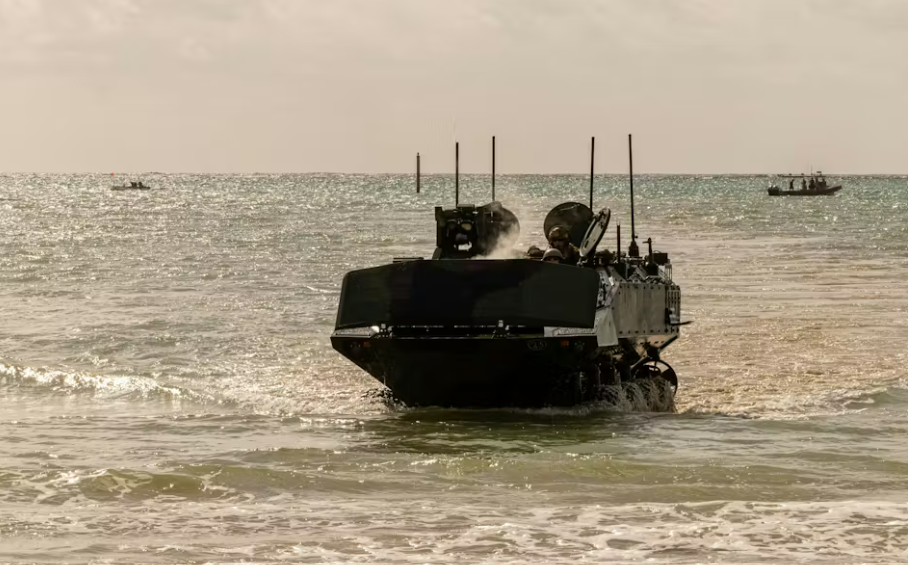
U.S. Marine Corps amphibious warfare experts are ordering 30 more amphibious armored combat vehicles and accompanying vetronics to replace the Corps’s ageing fleet of amphibious assault vehicles (AAVs).
Officials of the Marine Corps Systems Command at Quantico Marine Base, Va., announced a $188.5 million order earlier this month to the BAE Systems Platforms & Services segment in Sterling Heights, Mich., for 30 full-rate-production medium caliber cannon mission role variants of Amphibious Combat Vehicles (ACVs). The total cumulative value of the contract so far is $3.9 billion.
Wheeled combat vehicles
ACVs are wheeled armored combat vehicles able to move Marine infantry warfighters from ships offshore to fight their way onto invasion beaches. The Marine Corps could end up purchasing as many as 204 vehicles over the next few years to outfit some of its 10 amphibious assault companies — the first phase of an incremental approach to replacing the AAV, which entered service in 1972.
The ACV is designed to accommodate new capabilities as technology evolves, such as reconnaissance sensors, electronic warfare (EW) equipment, anti-air sensors and weapons, and integration with uncrewed aircraft.
BAE Systems delivered the first vehicles in November 2019 to the 1st Marine Division. The first batch of 18 ACVs went to a platoon of the 1st Marine Division’s 3rd Assault Amphibian Battalion at the Marine Corps Air Ground Combat Center in Twentynine Palms, Calif.
BAE Systems engineers base their ACV design on the Superav 8×8 amphibious armored personnel carrier developed by the Italian company Iveco Defence Vehicles.
Operate in direct fire
ACV systems are designed to operate through enemy direct fire, indirect fire, and land mines with low-profile visual and infrared signatures, modular protection, and other armored vehicle technologies.
The vehicles can swim to shore from as far as 12 miles out to sea, switch from operating in the water to ground operations without pause, and then maneuver with M1 Abrams main battle tanks in a mechanized task force. The ACV can destroy relatively light enemy combat vehicles similar to itself.
The ACV will provide direct fire support for Marine infantry, and can carry 17 Marines at speeds of at least eight knots at sea amid waves as high as three feet.
On shore, the ACV has high-ground clearance and a V-shaped hull to resist the effects of land mine blasts, and can operate with a wheel blown off. Each ACV has a crew of three, an M2.50 caliber machine gun in a remote weapons station, with the potential to install a stabilized dual-mount M2/Mark 19 grenade launcher turret.