The US Army is working on an update to its Tactical Wheeled Vehicle Strategy over the next three months that will envision how its evolving vehicle arsenal fits in the future fight.
“The Army is changing, but I would submit we’re not just changing … we’re transforming,” said Col. William Arnold, the Army’s chief of transportation. “We’re thinking differently in the wheeled vehicle fleet, and how we get there in the future as well.”
Arnold said his team is working on an update to “our entire tactical wheeled vehicle strategy” over the next three months, which was last published “right before I took the seat” in 2024.
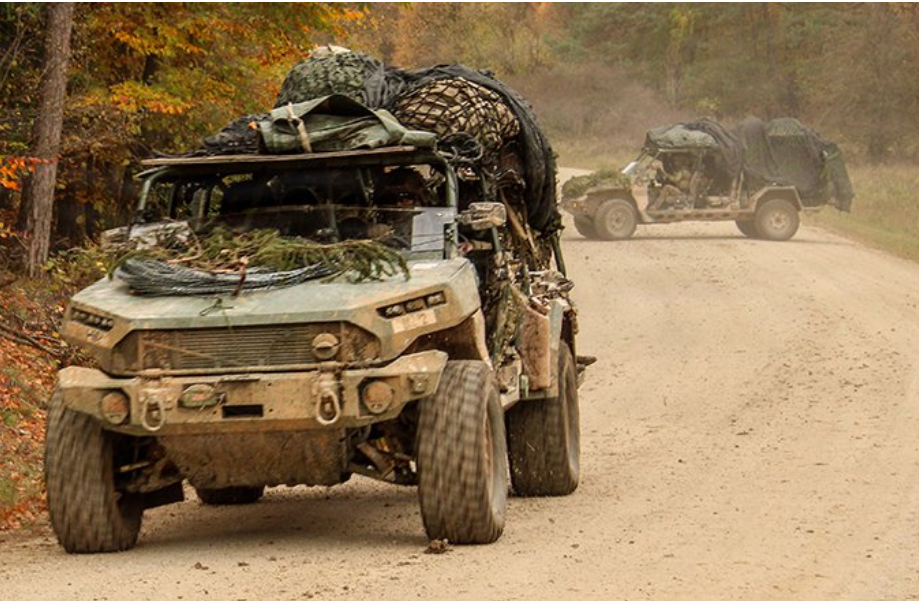
The update will incorporate plans for vehicles like the Army’s new Infantry Squad Vehicle, Arnold said at the National Defense Industrial Association’s Tactical Wheeled Vehicles Conference Feb. 24. The strategy will be updated “here in a sprint, really, over the next couple of months.”
The modernization strategy for the fleet hinges on three pillars, he said: optimizing for contested logistics, buying “game-changing technologies” and accelerating commercial off-the-shelf solutions.
“I think our fleet must sustain dispersed forces under constant threat,” he said, meaning vehicles must have mobility and technologies like the ability to offboard power one day, so that we can support smaller, agile units that can aggregate and disaggregate with unprecedented speed.”
Regarding “game-changing” technologies, Arnold said the Army “cannot simply buy more of the same” and plans to make targeted investments in things like predictive logistics, hybridization and exportable power.
He also said the Army plans to “aggressively leverage commercial off-the-shelf and modified COTS solutions to harness the incredible pace of commercial innovation” and “negotiate where we can in intellectual property and data rights needed for organic repairs and lifecycle sustainment.”
Within the transportation modernization portfolio, Arnold said three “significant” capabilities rise to the top: the Autonomous Transport Vehicle System, the Common Tactical Truck and the Medium Modular Equipment Transport.
“These three signature capabilities are really important to achieve the agility we need on the battlefield to continue to sustain,” he said.
The Autonomous Transport Vehicle System, designed to enable tactical vehicles to conduct autonomous logistics operations, is the “centerpiece of our strategy,” Arnold said. “To achieve the agile sustainment we need in the future, ATV-S will enable leaders to decide how to and when to employ either a manned vehicle or an unmanned vehicle into smaller elements based off of the threat.”
The technology will mitigate risk from fatigue taking the soldier out of the seat when required, allowing for longer operations and greater endurance, he said. “We get about 12 hours out of a workday, out of our crew that we have soldiers behind. But if we integrate autonomy, we can generally go 24 hours, and we can continue to push.”
“I believe this autonomy technology is the game changer that we’re going to see, similar to when the truck was introduced in the military in the early 1900s,” he said. “And so, it’s really important to the strategy.”
Another top priority, the Common Tactical Truck, is “the future cornerstone of our logistics fleet,” Arnold said. By replacing multiple aging vehicles such as the M915 Line Haul Tractor, M1088 Medium Tractor, Palletized Load System and Heavy Expanded Mobility Tactical Truck “with a COTS-based platform, we can significantly modernize our fleet and gain [the] benefit of a mobile, global supply chain,” he said.
Finally, the Medium Modular Equipment Transport “is a versatile platform” that will “adapt to diverse cargo needs while critically offering things like modular load flexibility,” he said. “We envision it as a [highly] mobile solution that is capable of potentially generating, storing and exporting power” while delivering supplies forward “on the battle edge.”
As the Army prepares its next Tactical Wheeled Vehicles Strategy, it’s “going to look a little bit different,” he said. “You’ll see a little bit different flavor inside of there to make sure we capture holistically the direction we need to go.”
The strategy is a living document that will evolve, “especially as we do organizational changes that change the battlefield calculus,” Arnold said.