Sikorsky executives feel that artificial intelligence and automation will play an increasingly important role in manned helicopters.
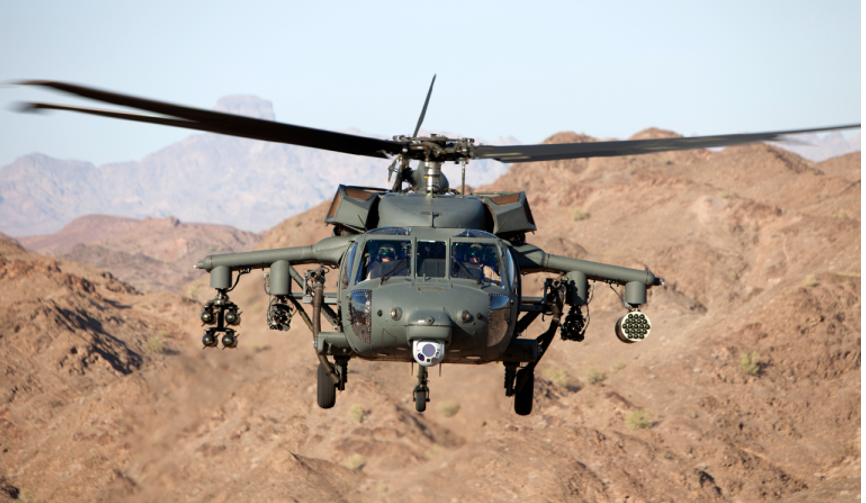
The company has done extensive work on automatic flight, most notably with its Matrix technology, which can fly aircraft, including the UH-60 Black Hawk, autonomously.
Sikorsky has demonstrated autonomous flight for the Black Hawk
In addition, company executives see the Black Hawk, its variants, and other helicopter types becoming increasingly networked with other assets. And as combat becomes more complex, autonomy will play an increasing role.
Jay Macklin is a former US Army Black Hawk pilot who leads the company’s army and air force strategy. He says that ultimately, the degree of autonomy depends on the customer.
“Do we believe that five Black Hawks will land in a field, and the infantry jump on, look up front and see nobody there? The technology could do that today, but are we ready for that? It’s up to each customer to decide,” he notes.
Still, autonomy can play a role in missions such as moving cargo – not people – in contested situations. Or, autonomy can serve as an aide to a pilot, assisting in degraded visual environments, or helping a pilot manage unmanned air vehicles.
Frank Crisafulli, a director at Lockheed and a former US Marine Corps helicopter pilot, also foresees increased autonomy.
Crisafulli describes an environment where helicopters are key nodes, networked with other aircraft, ships, vehicles, and soldiers. At some point this interaction may not even involve the pilot.
“How can I be a processor of data or affect targets if I’m not even the one who knows that I’m doing it?” he asks. This could even include the tasking of a helicopter’s sensors without the crew’s direct involvement or knowledge.
As to whether pilots are comfortable with something like this, Macklin and Crisafulli feel that there will be an evolution as crews become more familiar with automation.
Macklin adds that in such a scenario, the aim would be to task the sensor remotely, pass the data back, while not disrupting the pilot’s primary mission.
“The intent is for the right sensor to see the right target at the right time so the right munition can service it,” adds Macklin.