As NATO adapts to the evolving character of warfare in the 21st century, the space domain has emerged as a critical front for securing peace, ensuring deterrence, and maintaining the Alliance’s operational edge. At the forefront of this transformation is Allied Command Transformation, which is leading the effort to integrate space into NATO’s Multi-Domain Operations framework and strategic planning. 

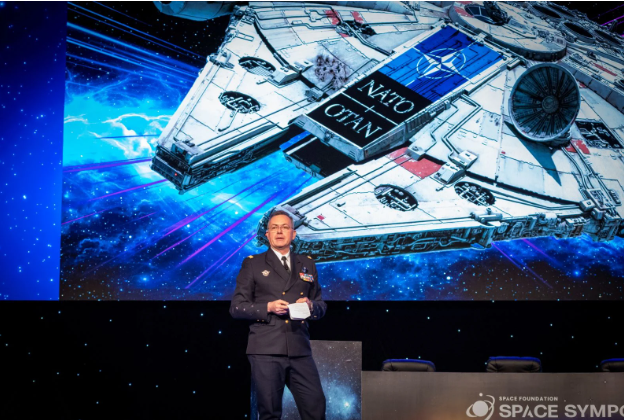
At the 40th Space Symposium, held  in Colorado Springs, Colorado, NATO underscored this transformation with a strong and visible presence. A highlight of NATO’s participation was a keynote address delivered by Admiral Pierre Vandier, NATO’s Supreme Allied Commander Transformation. In a speech that balanced strategic urgency with visionary clarity, Admiral Vandier emphasized the Alliance’s rapid evolution in the space domain.

To move ahead, we need to change the way we contract, the way we work with our partners, the way we build our capacities. We need to prefer to accomplish 80% today instead of 100% in years. We need to overcome the fear of change, which is not easy. We need to change our posture to be able to deter, and not only to react and complain.

– Admiral Pierre Vandier
Supreme Allied Commander Transformation

Admiral Vandier used powerful imagery to describe NATO’s trajectory, likening the Alliance to a seasoned but agile spacecraft, “a 76-year-old Millennium Falcon”, capable of navigating a rapidly evolving and contested environment. His message focused on the importance of NATO transitioning from a passive consumer of space services to an active guardian of space assets, advocating for greater readiness, robust capabilities, and an integrated civil-military space architecture. His remarks set the tone for NATO’s broader engagement at the event and highlighted his command’s strategic role in shaping NATO’s space future.

Shaping a Vision for NATO in Space

Under Allied Command Transformation’s leadership, NATO has developed a comprehensive Space Domain Vision that defines objectives beyond 2030. This vision is anchored in three priorities: integrating space into Multi-Domain Operations, strengthening and sustaining resilient space capabilities, and ensuring operational readiness in the face of emerging threats. 

NATO has made significant strides in recent years. The establishment of the NATO Space Operations Centre, integration of commercial space services, and improved mechanisms for Space Domain Awareness have positioned the Alliance to act more decisively. Allied Command Transformation continues to lead efforts to ensure these gains translate into operational advantage across all domains. 

The Command’s vision recognizes that effective deterrence and defence in space requires not only technological capabilities but also a coherent operational framework, human expertise, and the ability to act at the speed of relevance. Through persistent training, realistic exercises, and robust planning processes, Allied Command Transformation is fostering a culture of readiness that includes the space domain as a core element of NATO’s deterrence posture. 


Addressing Space Threats Through THOR

Among the Command’s leading contributions is its role in advancing the Space Threats Operational Response (THOR) initiative: a “One NATO” effort that brings together NATO’s Allied Command Transformation, Allied Command Operations, Combined Force Space Component Command, NATO Communications and Information Agency, and NATO Headquarters. THOR is designed to provide NATO with a full range of military options to respond to space-based threats. 

As adversaries develop offensive capabilities, including GPS jamming, cyber-attacks on space systems, and proximity operations in orbit, NATO’s space architecture must be capable of operating in contested, disrupted, degraded environments. THOR offers NATO senior leaders pre-developed “playbooks” to respond to such threats, including options tailored to crisis scenarios. Allied Command Transformation is responsible for ensuring these responses are strategically coherent and operationally viable. 

THOR also supports a broader shift in NATO’s space culture, moving from monitoring to proactive deterrence. These operational concepts are embedded in the THOR initiative, which ensures NATO and its nations are equipped with credible response options that enhance resilience and help maintain freedom of action in space. 


Reinforcing Resilience and Partnership

Allied Command Transformation recognizes that space resilience is not solely about technology, it also requires partnership, shared awareness, and synchronized action. The command has spearheaded efforts to build a federated model of Space Domain Awareness, drawing on national, partner, and commercial capabilities. This integrated approach enables NATO to maintain a continuous and shared understanding of the space environment. 

Partnerships with industry, academia, and non-NATO entities are also central to Allied Command Transformation’s approach. It continues to facilitate dialogues on dual-use space technologies, legal frameworks, and strategic communication, all essential components of responsible and effective space governance. NATO’s leadership in promoting norms of responsible behavior in space remains a core aspect of its strategic agenda.


NATO’s Broader Presence at the Space Symposium

In addition to Admiral Vandier’s keynote, several senior NATO officials contributed to key discussions throughout the symposium: 

  • Major General Devin Pepper, United States Space Force, who serves as Allied Command Transformation’s Deputy Chief of Staff for Strategic Plans & Policy, spoke on a panel titled “New Generation Space Leaders.” This panel was part of a dedicated program for space professionals aged 35 and under, aimed at empowering and mentoring the next generation of leaders shaping the global space enterprise. 
  • Colonel Jonathan Whitaker, United States Space Force and Chief of Staff of NATO’s Combined Force Space Component Command, participated in a panel focused on “New Entrants – Capabilities.” The session highlighted how emerging actors in the space domain are contributing to capability development and innovation across the space community. 
  • The panel titled “NATO’s Vision for Space” featured three senior NATO representatives: 
  • Mr. Thomas Goffus, NATO Assistant Secretary General for Operations 
  • Vice Admiral Jeffrey Hughes, United States Navy, Deputy Chief of Staff for Capability Development at Allied Command Transformation 
  • Air Marshal John Stringer, Royal Air Force, Deputy Commander, NATO Combined Force Space Component Command 

This panel explored NATO’s strategic and operational approach to the space domain, interoperability among Allied space assets, and the critical role of partnerships in delivering space-enabled effects across all domains.


A United Trajectory Toward the NATO Summit

As the Alliance prepares for the NATO Summit in June 2025, Allied Command Transformation’s work in the space domain has laid the groundwork for future decisions. Through its strategic vision, practical initiatives like THOR, and leadership at international events such as the Space Symposium, the Command is helping to position NATO as a credible, cohesive actor in the space domain.

Allied Command Transformation’s message is clear: space is no longer a distant frontier. It is now a defining domain of modern security—and NATO must be ready to defend it.

LEAVE A REPLY

Please enter your comment!
Please enter your name here